Technical report · GRPO · 2026
When is GRPO worth it?
A compute- and risk-aware comparison of GRPO, supervised fine-tuning and a linear baseline for banking intent routing. With labels available and tiny models, GRPO trailed supervised fine-tuning, which trailed TF-IDF with logistic regression.
Research question
Does GRPO earn its cost when labels already exist?
Group Relative Policy Optimization is widely used to post-train language models against a verifier. Routing customer messages is a different kind of problem: gold labels exist, compute is limited, and some errors cost far more than others. Sending a stolen-card report to a fees queue is worse than confusing two routine questions. The study asks whether GRPO is worth using in that setting, and whether a reward that encodes those costs reduces the errors that matter.
Scope
No new algorithm is proposed. GRPO-versus-SFT comparisons, cost- and abstention-aware rewards, and the measurement of advantage collapse all have precedents. The contribution is a joint evaluation under explicit accounting: every prompt scored by GRPO’s verifier is counted as a labelled example, CPU time is measured, and every method is compared with sending all requests to manual review.
Experimental design
One policy, several objectives, shared budgets.
Eight BANKING77 intents are routed to their own queues, four of them designated high-severity by assumption. A ninth action sends the request to manual review, which is also the correct response to out-of-scope messages. Every neural method trains the same parameters of the same language model, restricted to nine single-token actions, so only the objective differs.
- Models
- Pythia-14M (main study) · Pythia-31M (reduced replication) · all weights trained
- Data
- BANKING77 · 1,106 / 234 / 480 train / validation / test requests · near-duplicates of test removed
- Methods
- TF-IDF + logistic regression · SFT · cost-weighted SFT · GRPO (binary and cost reward) · rejection-sampling fine-tuning
- Budgets
- Distinct labels, verifier calls, optimiser steps, forward and backward passes, CPU seconds, peak memory
- Costs
- Hypothetical matrix · critical misroute 10 · manual review 0.5 · nine alternative matrices for sensitivity
- Statistics
- Five seeds per configuration · paired bootstrap over seeds and test examples · Holm correction
Results
Supervised learning won at equal labels, and a linear model won overall.
With all 1,106 labels, supervised fine-tuning of Pythia-14M reached 0.787 accuracy. GRPO with a binary reward reached 0.608 on the same examples. TF-IDF with logistic regression reached 0.860 in under one CPU second. Quadrupling GRPO’s verifier budget raised the cost-reward variant only to 0.645.
Zero-based scale from 0 to 1. Mean over five training seeds, argmax decision rule. GRPO and rejection sampling use group size 4 and 8,192 verifier calls.
| Method | CPU seconds | Accuracy | Expected cost | Critical-error rate |
|---|---|---|---|---|
| TF-IDF + logistic regression | < 1 | 0.860 | 0.613 | 0.050 |
| Supervised fine-tuning | 332 | 0.787 | 0.909 | 0.113 |
| Cost-weighted fine-tuning | 326 | 0.779 | 0.956 | 0.121 |
| Rejection-sampling fine-tuning | 165 | 0.671 | 1.319 | 0.182 |
| GRPO, cost reward | 167 | 0.637 | 1.405 | 0.204 |
| GRPO, binary reward | 170 | 0.608 | 1.711 | 0.265 |
Expected cost uses the study’s hypothetical cost matrix. Sending every request to manual review costs exactly 0.5, which is lower than every argmax router in this table. CPU seconds are single-thread training time on one laptop and include GRPO’s 64-example warm start.
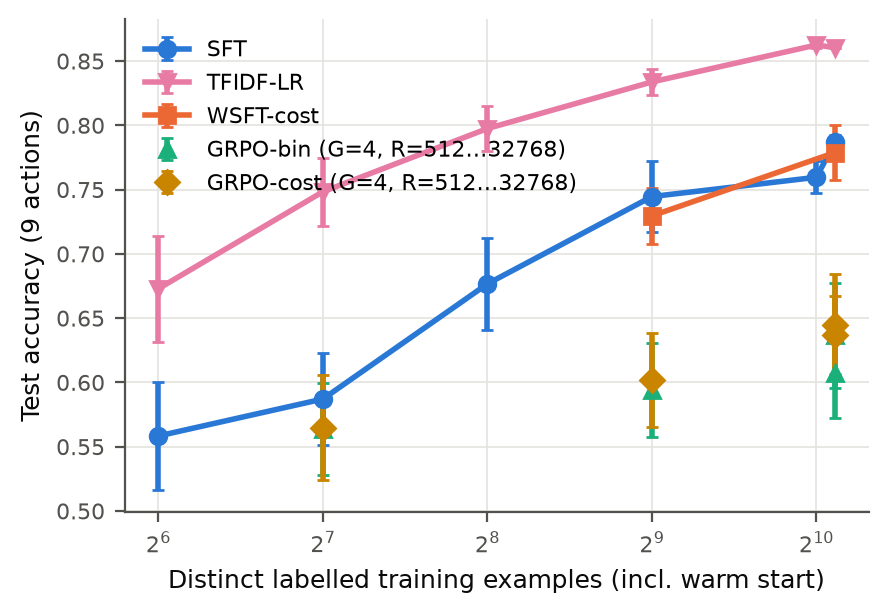
Most verifier calls bought no learning signal.
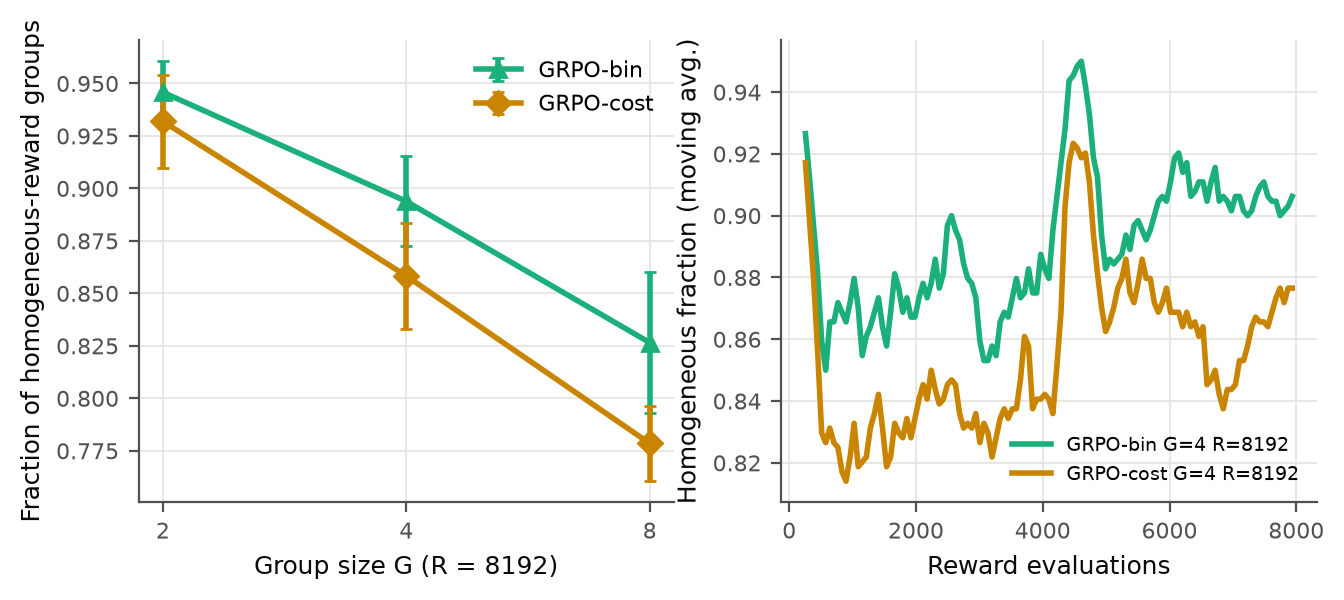
GRPO learns from differences in reward within a group of sampled actions. In every configuration, between 77.9% and 99.7% of groups received identical rewards, so their advantage was zero and they contributed no policy gradient. The fraction fell as groups got larger and was lower for the cost reward than for the binary reward.
Risk
The decision rule mattered more than the training objective.
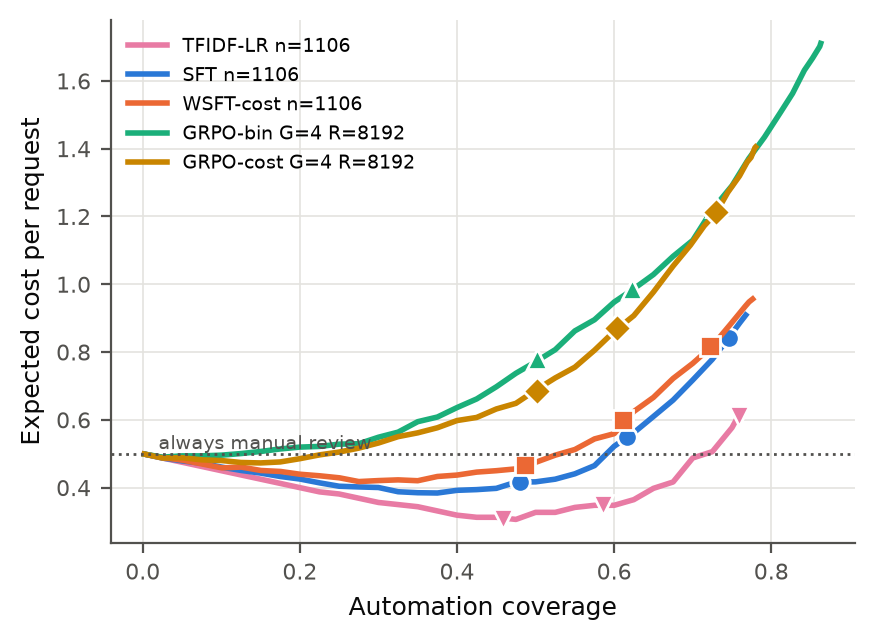
Replacing GRPO’s binary reward with the negative decision cost lowered its expected cost by 0.31 (95% interval 0.18 to 0.44) and its critical-error rate from 0.265 to 0.204. Part of that came from sending more requests to review. It still left GRPO behind plain supervised fine-tuning, and cost-weighted fine-tuning gave no benefit over the unweighted version.
The largest reduction came after training. Applying a minimum-expected-cost rule to the same supervised probabilities cut the critical-error rate from 0.113 to 0.068 and expected cost from 0.909 to 0.689. With a validation-calibrated abstention threshold at about half of traffic automated, TF-IDF with logistic regression cost 0.308 and supervised fine-tuning 0.417. No GRPO configuration fell below the always-review cost of 0.5.
Scaling check
Doubling the model left the conclusions unchanged.
A reduced replication with Pythia-31M used the same splits, seeds and evaluation code. Supervised fine-tuning reached 0.804 accuracy and 0.887 expected cost; cost-reward GRPO reached 0.642 and 1.278. The cost reward still beat the binary reward within GRPO, and GRPO varied less across seeds at the larger size. A twofold change at this end of the scale is far from the model sizes at which GRPO is usually applied.
Interpretation
What the study does and does not show.
This is the setting where supervised learning should be expected to do well: the verifier is an exact comparison with a gold label, so a cross-entropy step uses the whole label while a GRPO group sees only whether its sampled actions were right.
Supported within this setting
- With labels available, start with a linear baseline before a neural model.
- Add a cost-aware decision layer before changing the training objective.
- Count verifier-scored prompts as labelled data when comparing methods.
- Measure the share of identical-reward groups on a pilot before investing in GRPO.
Not established
- Anything about GRPO for multi-token reasoning or generation, or at the model sizes where it is normally used.
- Real operational savings: the cost matrix and the severity split are assumptions, not measured losses.
- Robustness to real distribution shift: prevalence shifts and wording perturbations were simulated.
- The best achievable GRPO: learning rates came from a single-seed pilot and other settings were fixed in advance.